Can a Dutch startup afford a Bay Area hire?
How Dutch tech founders can talk about compensation with US candidates without confusing legal thresholds, survey medians, and market offers.
Updated
A founder and a candidate can be enthusiastic about the same role while imagining very different numbers. The work sounds right. They like each other. Then the conversation reaches compensation, and both wonder whether they have misunderstood the opportunity.
My reference point is San Francisco, so I take that gap seriously. A move can mean giving up substantial savings as well as changing a salary. I also want a Dutch founder to be able to speak plainly about what the company can sustain. There is more chance of finding an agreement when neither person has to disguise the question they are carrying.
Name the gap without apologizing for it
Candidates from the US often arrive with a different reference point for base pay, equity, and benefits. Ask what their current package includes and explain how yours is structured.
I would suggest saying the gap out loud early. Explain the role’s budget as an annual figure, the working hours it assumes, and what sits outside base pay. If equity is part of the story, describe the class of shares, the vesting, and what is still unknown. Show the annual cash figure separately from equity and benefits.
You do not need to defend the entire Dutch labour market. You need to make this offer understandable. A candidate can decide that the total arrangement works for their life, or that it does not. That decision is easier when the comparison is complete.
Three numbers. Three jobs.
Keep survey context, legal criteria, and your offer in separate boxes.

Survey medians
Broad context across respondents, not matched jobs.
Permit criteria
Legal thresholds for a route—not market-pay advice.
Your offer
What this company can fund for this scope.
A clearer compensation talk
Show the amount, what it includes, and why it is being quoted.
Separate survey medians, legal thresholds, and offers
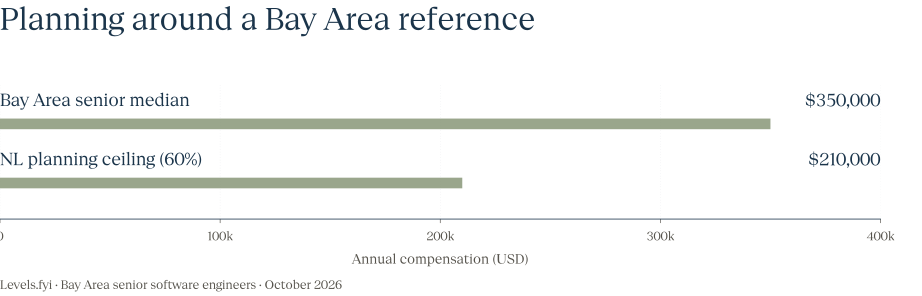
For a candidate leaving a senior Bay Area role, a US-wide median is the wrong anchor. Levels.fyi's Bay Area senior-engineer data puts median total compensation at $350,000. Treat base, stock, and bonus separately. The relocation budget in this series uses 60% of a comparable Bay Area package as an optimistic assumption. Set your actual offer against the role and the market you are hiring in; some European employers pay considerably more.
Legal salary criteria for residence routes are a different kind of number again. The IND’s highly skilled migrant pages set out salary criteria that apply to that permit route. A criterion is a condition for sponsorship eligibility under the rules that apply. It is not a recommendation for market pay, and meeting it does not mean the offer is competitive. Read the IND overview and confirm the current figures with a qualified adviser before relying on them.
Your offer is a third number: what this company can pay for this scope, with these benefits, at this stage. Keep the three categories separate in conversation. Mixing them creates false confidence on both sides.
| Kind of number | What it can tell you | What it cannot tell you |
|---|---|---|
| Survey median | Broad context across respondents | What this candidate or this role should pay |
| Permit salary criterion | Whether a route’s legal threshold is met | Whether the offer is attractive or fair market pay |
| Your budgeted offer | What you can actually provide | How the candidate values the whole life change |
Once both people can see the gap, they can talk about the decision with more care. Perhaps the role offers something the candidate wants enough to accept a different financial future. Perhaps it does not. They need time and enough information to work that out for themselves.
Planning around a Bay Area reference


Budget below this assumption; higher-paying exceptions remain possible.
Sources & calculation notes
Source: Levels.fyi · Bay Area senior software engineers
The Dutch bar is a planning assumption, not measured pay or a market maximum.
- Population
- 5,997 self-reported senior-engineer packages.
- Measure
- Reported median; second bar is median × 60%.
- Source location
- Median total compensation; checked 30 October 2026.
- Checked
| Group | Value |
|---|---|
| Bay Area senior median | $350,000 |
| NL planning ceiling (60%) | $210,000 |
Explain the whole package in plain language
US candidates may treat base salary as the main signal and equity as upside. Dutch packages often include holiday allowance, pension contributions, and statutory leave that change the picture. Explain unfamiliar terms. Explain each item and whether it is guaranteed.
Ask what the candidate needs to compare: monthly or annual figures, currency, working hours, leave, healthcare arrangements, and any continuing US tax obligations they may need advice on. Leave time for them to take tax advice before deciding.
Equity deserves particular care. A percentage in an early company is not the same as listed stock at a large US employer. Say what is known, what depends on future events, and who can answer detailed questions. Overpromising future value damages trust faster than a modest, clear offer.
Put the package on one page.
US candidates often need the Dutch structure spelled out.

Base and hours
Annual figure, currency, and working time assumed.
Statutory pieces
Leave, holiday allowance, and pension as they apply.
Variables
Equity, bonuses, and relocation support with unknowns named.
Room for a real decision
Share enough that advice and comparison become possible.
Prepare the compensation conversation
- Write the offer in one page. Base pay, hours, leave, holiday allowance, pension, equity, relocation support, and anything still undecided. Share it before a verbal close whenever you can.
- State the currency and the period. Annual euros for a 40-hour week is a different sentence from a monthly figure with unspecified hours.
- Separate legal from commercial language. If a figure exists because of a permit criterion, say so. Do not present the criterion as proof that the pay is market-competitive.
- Ask what the candidate is optimizing for. Cash now, runway, ownership, location, pace, and family logistics lead to different tradeoffs. Listen before defending the spreadsheet.
- Leave time for advice. Cross-border tax and immigration questions belong with qualified professionals. Build that pause into your process instead of rushing a signature.
For hiring teams
Discuss pay before asking the candidate to commit to several interview rounds. Publish a meaningful range when you can. If you are still choosing between two levels, say so. Candidates from another market need more explicit framing, not less.
If the gap is too large for the role you can fund, decide early. Stretching every hire to the edge of the budget creates retention problems later. A clear no, with respect, is better than an offer that only works if the candidate never recalculates.
Sometimes the conversation ends with a respectful no. Sometimes it reveals a workable offer neither side could see at first. Either outcome is easier to live with when the figures were clear and the candidate had room to consider what the move would mean for their life.
About this essay
Based on client conversations, with details omitted and examples adapted. The chart labels the 60% budgeting assumption separately from the reported compensation. Sources were checked on 30 October 2026. Take qualified advice on tax and immigration requirements for an individual offer.