The title says Staff. What does your startup actually need?
How Dutch startups can read US seniority signals, define the job they need, and avoid hiring the wrong scope by title alone.
Updated
A résumé arrives with a Staff Engineer title and work at a company your team knows well. It is easy to feel excited about what that experience might bring. It is also easy to leave the hardest question unasked: what would this person spend their days doing here?
I would start there. A small Dutch startup may need deep technical judgment, help developing other engineers, and someone willing to pick up work that has no owner yet. The candidate deserves to see that combination clearly enough to decide whether it is work they would enjoy.
Titles travel poorly across companies and countries
Inside a large US tech organization, levels often come with shared expectations, calibration, and compensation bands. A candidate may be used to that shared language. Your startup may have three engineers and a founder who still reviews pull requests. The same word does not describe the same job.
Ask what the title meant in practice. What could they decide alone? What needed approval? Whom did they unblock? What broke when they were away? Use the answers to compare their previous responsibilities with the role you are offering.
Be equally careful in the other direction. A strong IC from a large company is not automatically ready to own hiring, vendor choices, and product tradeoffs in a ten-person team. Equally, a smaller company’s unfamiliarity with a US level does not erase the judgment the person already has. Investigate both the strengths and the gaps.
Start from the work.
A US title is shorthand from somewhere else.

Decisions
What must this hire decide in the first six months?
Depth or breadth
Specialist ownership, generalist range, or people leadership?
Boundaries
What will this seat deliberately not own?
A scope you can interview against
Add a title after the job is clear.
Define the scope you actually need
Before interviewing, write down the decisions this hire must make in the first six months. Which problems would you be relieved to put in their hands? Be specific about those before the appeal of a familiar company name carries the conversation elsewhere.
I would also ask whether you are hiring for depth, breadth, or leadership of others. Those are different jobs. US candidates may have specialized deeply inside a large system. Dutch startups often need someone who can move between product, people, and unfinished process. Decide which responsibilities the hire needs to cover.
If you are unsure, say so in the process. “We are deciding between a strong individual contributor and a player-coach” is honest. Letting candidates invent the job from your enthusiasm is how mismatched expectations begin.
| Signal | Useful question | Risk if skipped |
|---|---|---|
| Title | What decisions sat with you? | Importing a rank that does not exist here |
| Company size | What did you personally own end to end? | Assuming platform fame equals personal scope |
| Management | Did you hire, coach, or only advise? | Confusing mentorship with people leadership |
| Ambiguity | How did priorities get set when plans changed? | Hiring for a stable ladder into a fluid startup |
This is where curiosity helps more than admiration. Ask the person to take you through a difficult week in their last role. Listen for what they noticed, what they took responsibility for, and where they needed others. Then give them an equally honest picture of a week in yours.
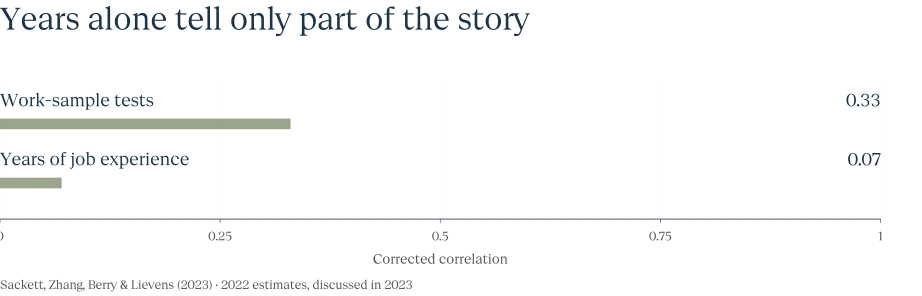
Years alone tell only part of the story


Assess relevant work, rather than treating years served as a complete assessment.
Sources & calculation notes
Source: Sackett, Zhang, Berry & Lievens (2023)
Not success percentages or a causal comparison. Study settings vary; this does not mean experience has no value.
- Population
- Meta-analytic estimates across employment settings.
- Measure
- Corrected mean correlation with overall job performance.
- Source location
- Table 1, p. 285, work samples and job experience rows.
- Checked
| Group | Value |
|---|---|
| Work-sample tests | 0.33 |
| Years of job experience | 0.07 |
Test the level in the interview, not the LinkedIn headline
Give candidates a real slice of the work. A system design prompt copied from a big-tech loop may select for interview polish more than for your backlog. A conversation about a recent incident, a tradeoff you face this quarter, or a hiring decision you need to make soon will show judgment more clearly.
Listen for how they size problems. Do they reach for process that only works with dozens of specialists? Do they disappear into details and miss the business constraint? Do they ask what “done” means before proposing architecture? Level shows up in the questions as much as in the answers.
When feedback from interviewers disagrees—“too senior” versus “not senior enough”—treat that as a signal that your own level definition is fuzzy. Align the panel on the decisions the role owns before you ask them to score candidates against it.
Read the résumé twice.
Separate reputation from personal ownership.

Famous employer
Useful context. Still ask what they personally owned.
Elevated title
Ask which decisions travelled with the label.
Assess the work you need
Compare the candidate’s decisions with those this role requires.
Write the role so both sides can recognize it
- Describe outcomes and decisions, then add a title. The title should label the job, not replace the description.
- State what this hire will not own. Knowing the boundaries helps a candidate picture whether they would enjoy the work.
- Explain how leveling works today, even if the answer is “we are still building it.” Tell candidates what has been decided and what is still open.
- Ask candidates to map their last role onto your scope in their own words. Their translation is useful data.
- Separate compensation bands from vanity titles. Check how the title will fit alongside existing roles and future promotions.
For hiring teams
Do not use “overqualified” as a quiet rejection code for “we cannot afford this person” or “we are afraid they will be bored.” Those are different concerns. Name the real one. A candidate can respond to a budget limit or a hands-on expectation. They cannot respond to a vague label.
Give US candidates room to explain how work was organized without treating a famous employer as proof. Ask for examples you can assess against the role.
The title can come after you have a shared picture of the job. By then, both people should know what the experience could make possible and where the learning would begin. That is a much stronger reason to hire someone than the relief of recognizing a name on their CV.
About this essay
Based on questions raised in client conversations, with identifying details omitted and examples adapted for clarity. Use the advice as a starting point, and adapt it to the role and your company. Research sources and their dates appear alongside the chart.