Your new hire has a laptop. Do they know how to succeed?
How Dutch tech teams can onboard people relocating from the US: clarity on work, relationships, local context, and the first ninety days.
Updated
The laptop is ready. The calendar is full. Everyone has been welcoming. Still, a new colleague can finish the first week wondering which decisions are theirs to make and whether it is too soon to ask.
I want onboarding to make those questions easier to bring into the open. Someone arriving from the US may know the profession well and be learning the workplace all over again. A manager can help by explaining what matters first, making introductions with a purpose, and leaving room for the person to find their footing.
Orient the work before the culture deck
Give a written picture of the first thirty days: the problem to learn, the people to meet, the systems to access, and the first delivery that would prove progress. Explain why each introduction matters and what the person can help with.
Explain how priorities are set and changed. US joiners from larger companies may expect product councils, written RFCs, or manager cascades. Your startup may decide in a hallway and a Linear ticket. Show the new hire where decisions are recorded and how to raise a disagreement.
Explain the funding constraints, customer commitments, and unfinished parts of the product. The new hire needs that information to judge where to spend time.
Pair them with a practical buddy who is not their manager. The buddy answers “how do I get a desk pass” questions. The manager answers “what good work means” questions. Combining both roles in one overloaded teammate is how both suffer.
Draw the first thirty days.
Explain the work alongside the tools.

Problem to learn
What should they understand first?
People to meet
Introductions with a reason attached.
First delivery
A small completion that proves progress.
Less guesswork each week
Ask what they can now do independently and where they need help.
Explain how you decide, disagree, and review
Spell out decision rights for the role. What can they ship without asking? What needs a founder nod? How are incidents discussed afterward? People from strong US feedback cultures may expect blunt notes; others may expect formality. Show your actual pattern with examples from recent weeks.
Probation or early review points should not be a surprise. If there is a formal probationary period, say what you will evaluate and when you will talk. Check the employment guidance with the person responsible for your contracts, then explain the review arrangements to the hire.
Invite questions about communication norms: meeting punctuality, Slack response expectations after hours, and whether cameras are default. Do not assume they already have someone nearby to ask.
| Onboarding need | Manager owns | Buddy / ops can own |
|---|---|---|
| Success criteria | Definition of good early work | — |
| Access and tools | Priorities for which systems matter | Accounts, hardware, basic how-to |
| Team norms | Feedback and decision examples | Meeting hygiene, channels map |
| Local settling | Time and empathy for admin load | Checklists, office orientation |
There is a lovely possibility in those early questions: the new person may notice something the rest of the team has stopped seeing. If you make it comfortable to ask why a decision works this way, you may learn where your own process needs attention.
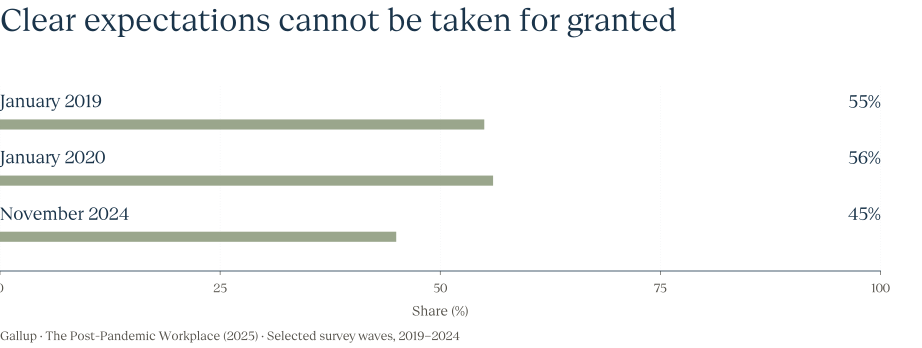
Clear expectations cannot be taken for granted


Do not assume that a new colleague knows what success means. Make the expectations explicit.
Sources & calculation notes
Source: Gallup · The Post-Pandemic Workplace (2025)
Selected waves, not annual averages. Descriptive survey results do not show what caused the change.
- Population
- US employees; item-level sample sizes not stated in the article.
- Measure
- Share strongly agreeing that they know what is expected at work.
- Source location
- Table “Less Than Half of U.S. Employees Know What’s Expected…”; January 2019/2020 and November 2024 rows.
- Checked
| Group | Value |
|---|---|
| January 2019 | 55% |
| January 2020 | 56% |
| November 2024 | 45% |
Local context is part of the job setup
Help them understand customers, regulators, and partners that shape the product in Europe if that differs from their US experience. Do not assume “tech is global” erases market context. A short briefing on your users beats leaving them to learn through a public mistake.
Language expectations should be explicit in the work, not only in the job ad. Which meetings are English? Which documents? Which customer calls? Revisit the agreement you made while hiring; onboarding is where vague promises become daily friction. See language expectations at work.
Make space for jet lag, housing hunts, and registration appointments in the first weeks. A team that treats settling logistics as lack of commitment will teach the wrong lesson about belonging.
Put recurring meetings on the calendar before day one: manager 1:1s, buddy check-ins, and the thirty-day review. People arriving into a new country already manage enough uncertainty.
Split buddy and manager.
Practical help and performance clarity are different jobs.

Buddy / ops
Tools, building logistics, channel maps.
Manager
Success criteria, decisions, and feedback.
Support that can scale
One overloaded teammate should not own both.
Structure the first ninety days
- Week one: access, safety, introductions with purpose, and one small completed task.
- Week two: a written 30-60-90 draft the hire helps edit. Revise it together as they learn.
- Day thirty: a feedback conversation both ways. What is clearer? What is still opaque?
- Day sixty: adjust scope if the original bet was wrong. Agree any change in responsibilities.
- Day ninety: a substantive review against the criteria you named at the start. Use the criteria already discussed.
For hiring teams
Keep time available after the offer is accepted. An early conversation with a founder can resolve questions about priorities that colleagues may be unable to answer.
Let what you learn about each other shape the next few weeks. The original plan will almost certainly need adjusting, and that is a useful part of getting to know a new colleague.
A few weeks in, the calendar can tell you very little about how someone is settling. Ask what has become easier, what still feels unclear, and where they would like more responsibility. The next useful step should come from that conversation.
About this essay
Based on questions raised in client conversations, with identifying details omitted and examples adapted for clarity. Employment guidance was checked on 30 October 2026; confirm the arrangements for your contracts with HR or counsel.