Your experience crossed the border. Did your seniority?
How to make senior experience clear in a new job market without inflating your title or starting your story over.
Updated
At your old company, a title could do a lot of explaining for you. People knew the teams you worked with and the decisions that landed on your desk. Then you move countries and find yourself explaining work that used to speak for itself.
That can feel surprisingly personal. In client conversations, a question about level can quickly become a question about whether years of experience still count. I like to start with the work itself: the difficult decisions, the people who relied on you, and what you learned to notice. There is usually much more to talk about than the title allows.
A title carries less context than you think
At your old company, people may have known what your title meant. They understood the size of your team, the decisions you could make, and the work expected at your level. A new reader has none of that background. You need to explain a little of what sat behind the title.
A reader in another country may know the company name without knowing what you personally owned. They may also use the same title for a very different job. Describe the scope underneath the title.
I would start with three questions: What decisions could you make? What complexity did you handle? What changed because of your contribution? A clear answer to those questions travels further than a level code that only former colleagues recognize.
That does not mean every accomplishment needs a dramatic metric. A well-described change to a decision process, a program delivered across teams, or a difficult trade-off handled responsibly can show your level of responsibility. Use numbers when you have them and can share them. A careful explanation is enough when the result cannot be reduced to a number.
Let the work explain the level.
A title may be unfamiliar. These details help someone understand it.

Decisions
What could you decide, and what needed someone else’s approval?
Responsibility
Which people, problems, or pieces of work depended on you?
Contribution
What changed because of the work you did?
A clear picture of your experience
Keep the actual title. Add the context that makes it useful.
Separate the signals
There are several different things happening in a job search. A platform recommends roles. A recruiter interprets your profile. A hiring manager assesses your fit against a particular need. You decide which opportunities to pursue. Treating all four as one verdict makes it harder to identify what to change.
If alerts are irrelevant, revisit the settings, titles, and seniority filters. If conversations repeatedly begin below your intended scope, revisit your introduction. If the level seems right but interviews stall around a specific requirement, investigate that requirement. These are different problems with different responses.
A compliment in a rejection email is easy to read too much into. “Impressive background” may be sincere or simply standard wording. It does not explain whether the issue was your experience, the timing, or another candidate. You can take the message seriously without expecting it to explain everything.
| Signal | In a familiar US context | In a new Dutch search |
|---|---|---|
| Company title | May come with shared organizational context | May need a plain-language explanation |
| Scope | Can be understood through known teams and levels | Needs to be made explicit for the reader |
| The client’s alerts | No comparable sample in this series | Senior roles mixed with entry-level opportunities |
This is where the conversation can become less defensive. Once you are describing a piece of work you know well, you have something solid to stand on. The hiring manager can ask about a decision or a constraint, and you can begin to understand each other without settling the title first.
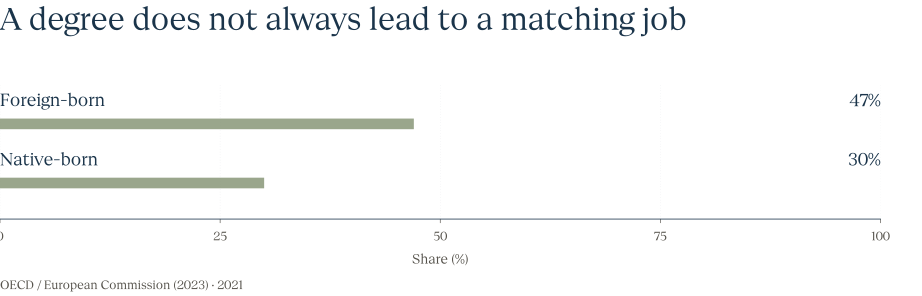
A degree does not always lead to a matching job


The wider gap is real. Explaining your experience can help a conversation, but cannot remove every barrier.
Sources & calculation notes
Source: OECD / European Commission (2023)
Combined indicator, not unemployment alone. Descriptive differences do not identify causes or predict an individual’s prospects.
- Population
- EU residents aged 15–64 with tertiary education.
- Measure
- Share either outside employment or working in a low- or medium-skilled occupation.
- Source location
- Indicator 3.12, paragraph beginning “Around one-third” and main findings.
- Checked
| Group | Value |
|---|---|
| Foreign-born | 47% |
| Native-born | 30% |
Explain your level honestly
Keep your actual title. Add a short explanation of the function or scope when it helps. A reader should never have to choose between an unfamiliar official title and a misleading replacement.
“I worked at a major technology company” leaves the reader to guess what you did there. Add the problem you worked on, who depended on it, and which decisions you made. Those details help a hiring manager place your experience.
This matters particularly when moving between functions or company sizes. Experience in a large organization does not automatically make someone ready to lead every function in a small one. Equally, a smaller company’s unfamiliarity with your former level does not make your judgment disappear. A good conversation investigates both the strengths and the gaps.
You can be confident and specific about what you bring while being honest about what you would need to learn. In fact, explaining the boundary of your experience can make the rest of the account easier to trust.
Match the change to the problem.
Different signals call for different responses.

Wrong job alerts
Check search terms, location, and level filters.
Wrong level in calls
Make your responsibilities clearer in your introduction.
The same interview gap
Ask what evidence is missing, then choose a stronger example.
Change one useful thing
Start with the part of the search you can investigate.
Help people understand your level
- Write a scope sentence. Under each relevant role, describe the work you owned, the people or functions involved, and the decisions you made. Keep it understandable to someone who has never worked at your previous employer.
- Audit the search inputs. Check saved titles, location settings, function, and seniority filters. Use the results as feedback about the search setup before treating them as feedback about your career.
- Ask how the role is leveled. Try: “What distinguishes success at this level from the level below and above it?” Listen for responsibility and expectations, not just the title on the vacancy.
- Make any deliberate step sideways explicit. A move into a new function or industry can be a thoughtful choice. Explain the capability you are building and the scope you can already handle, rather than leaving the reader to invent your reason.
- Get a local reading of your CV. Ask someone familiar with the target function what job they think the document is positioning you for. That is a more useful test than asking whether it looks impressive.
For hiring teams
Ask about scope before assuming the same title means the same job. Give candidates room to explain how work was organized, then compare their experience with what the job needs. A recognizable employer is context; it should not substitute for evaluation in either direction.
Be equally careful with the phrase “overqualified.” Is the concern compensation, motivation, willingness to do hands-on work, or something else? Those are questions you can talk about. A vague label closes a conversation that might otherwise clarify a perfectly workable fit.
You should leave that conversation with a clearer sense of the job, too. Being understood matters; so does finding work that gives your experience somewhere useful to go. A good translation helps both people see that possibility.
About this essay
Based on client conversations, with identifying details omitted and examples adapted for clarity.