The job offer is signed. The move is another project.
A planning checklist for Americans considering work in the Netherlands: identify the questions, find qualified help, and keep records.
Updated
Signing the offer can feel like the moment a move becomes real. Then the practical questions arrive: who handles the work permission, when can you register, what needs to happen to accounts back home? The excitement has to share space with a growing list of things you have never arranged before.
In client conversations, I want to make that list feel possible to work through. A person should be able to find the right help, understand the next step, and keep some attention for the life they are moving towards. Their employer has an important part in making that possible.
Make a map before making decisions
Start by separating the systems involved. Tax filing is one question. Tax owed is another. Reporting an account is another again. Residence and permission to work belong to a different set of rules. The same change in your life can create questions in more than one system without those systems using the same definitions.
That is why a reassuring answer from a friend may be incomplete even when their experience is accurate. Their situation, dates, employment arrangement, or account types may differ. Use conversations to identify questions and useful professionals, rather than treating another person’s outcome as a decision rule for yourself.
A short written overview can help an adviser see what needs attention. Keep personal documents in a secure place and share them through the adviser’s agreed channel. Ask which documents the adviser needs before sending them.
One move. Several separate questions.
An answer in one area does not settle the others.

Tax returns
Where must you file, and what rules apply to your income?
Account reporting
Are there separate reports for accounts or assets?
Right to work
Which permissions and employer responsibilities apply?
Ask the right specialist for each
Then check how the answers affect one another.
Keep the questions separate
The IRS explains that US citizens and resident aliens abroad are generally subject to the same filing rules and tax on worldwide income as those in the US. Whether a return is required and what tax is ultimately due depend on the applicable rules and circumstances. Moving does not by itself make US tax questions disappear. Start with the IRS overview.
Foreign-account reporting is a separate subject. The IRS’s FBAR guidance describes when US persons must report foreign financial accounts and explains that the report is filed with FinCEN. Ask a qualified adviser which reporting duties apply to you; do not assume that submitting an income-tax return addresses every reporting requirement. Read the official FBAR guidance.
On the Dutch side, the Tax Administration’s 2026 box 3 guidance describes the treatment of relevant savings and investments in the provisional-assessment system. It also explains the distinction between assumed returns and actual returns in that process. This does not establish how any particular US retirement account or equity arrangement should be classified. See the Tax Administration’s explanation.
Permission to live and work is another area where the right route matters. The IND describes different residence routes and their conditions, including a highly skilled migrant route. The applicable route depends on the individual’s circumstances. Consult the IND or an appropriately qualified adviser about the relevant route.
| Area | US questions to raise | Dutch questions to raise |
|---|---|---|
| Tax | Filing duties and treatment of worldwide income | Residence, filing duties, and relevant income categories |
| Accounts | Whether separate reporting applies | How particular assets or arrangements are classified |
| Employment | Any continuing obligations connected with the move | Work permissions and the employer’s responsibilities |
| Coordination | Who checks the interaction between systems? | Who checks the interaction between systems? |
The list becomes less intimidating when each question has somewhere to go. You can send the tax question to the tax adviser, ask the employer about reimbursement, and leave the unanswered items visible. You do not have to resolve the whole move in one sitting.
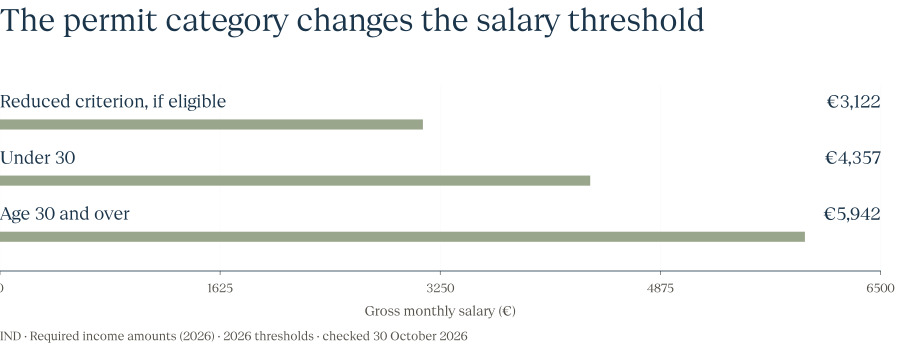
The permit category changes the salary threshold


The role and the move need separate checks. Confirm the relevant permit rules before relying on an offer.
Sources & calculation notes
Source: IND · Required income amounts (2026)
Legal thresholds, not market salaries. Eligibility, other conditions and renewal rules differ. Check current IND guidance for your case.
- Population
- First highly skilled migrant residence permits in the Netherlands.
- Measure
- Required gross monthly salary, excluding holiday allowance.
- Source location
- 2026 highly skilled migrant table, first-residence-permit column.
- Checked
| Group | Value |
|---|---|
| Reduced criterion, if eligible | €3,122 |
| Under 30 | €4,357 |
| Age 30 and over | €5,942 |
Find advisers who can work together
Someone can be excellent at tax work in one country and still not be the right person for a cross-border question. Ask about experience with the countries and types of issue involved. Be clear about what the service includes, what it does not include, and when specialist legal advice may be needed.
Ask who will check that the answers fit together. You may have one adviser for the US and another for the Netherlands. Find out how they will share information. Before acting, you need to know whether each has considered the advice from the other.
It also helps to distinguish preparing a return from advising on a decision before you make it. If you are considering an employment arrangement or a change involving an account, ask whether advice is needed before acting. A year-end filing appointment may be too late for the question you actually have.
Get advice before the decision needs it.
A filing appointment and advice about a planned move are different services.

Describe
The move, the decision, and the timing.
Agree
Which questions the adviser covers, fees, and what falls outside.
Coordinate
Who checks the connection between US and Dutch answers?
Record
Keep the advice and confirmed deadlines securely.
A plan with named responsibilities
Include what your employer supports and what remains yours to arrange.
Build a manageable checklist
- Identify the categories early. Write down tax filing, account reporting, work permission, and employer support as separate questions. Let qualified professionals determine which apply rather than crossing something off because it sounds unfamiliar.
- Find advisers with relevant cross-border experience. Ask about scope, fees, communication, and coordination. Confirm what information they need and how to share it securely.
- Keep a current document list. Record where the necessary information lives and what is still missing. Avoid creating multiple extra copies of sensitive documents simply to feel organized.
- Put checked deadlines in one calendar. Use the dates that apply to your circumstances, including any valid extensions. A general deadline found online is a starting point to check, not the final answer for every person.
- Ask the employer what support covers. Clarify whether relocation assistance includes qualified advice, how to access it, and which responsibilities remain yours. Get the practical details before assuming a broad benefits label answers the question.
For hiring teams
Make the handoff to qualified support easy to understand. Tell candidates what assistance exists, who provides it, and what falls outside it. Avoid giving personal tax or immigration assurances through people who are not responsible for assessing the individual situation.
There will still be unfamiliar forms and appointments. But with a clear plan and people who will answer, the move can begin to feel manageable. That leaves more room for the hopeful part: meeting the team, finding your way around, and starting to feel at home.
About this essay
Based on client conversations, with identifying details omitted and examples adapted for clarity. Official sources were checked on 30 October 2026. This is not tax or legal advice; obtain qualified advice for your own circumstances.