“Just a chat” can still decide who gets hired
Prepare for a conversational interview without turning it into a rehearsed performance. Warmth and structure can work together.
Updated
“Just a chat” sounds reassuring until you sit down to prepare for it. Should you have slides? A polished introduction? Will it be an interview in everything but name? Clients often want to arrive relaxed while still giving the conversation the attention it deserves.
I would rather help someone find a few stories they can talk about comfortably than send them in with a script. The aim is to have enough footing to listen. Somewhere in the exchange, the other person may tell you what they really need help with; you want to be present when that happens.
Prepare for the question beneath the question
An interviewer may start with “Tell me about yourself.” You do not need to begin with your first job. Choose the parts of your experience that help them understand why you are here. In a short call, a focused introduction leaves more room for a useful discussion.
Instead, decide what this interviewer needs to understand. Why does the role interest you? Which parts of your experience are relevant? What are you hoping to do next? Those questions can provide enough structure for a natural answer without requiring a memorized speech.
Leave some space in the conversation. If you are concentrating on delivering every sentence you practiced, you may miss the moment when the interviewer reveals what they actually need. A shorter introduction leaves space for that information to arrive.
You are also allowed to clarify. “Would it help to focus on the leadership work or the earlier product experience?” is a reasonable question. It turns a broad invitation into a conversation rather than a guessing exercise.
Give your story a simple shape.
Prepare the points you want to explain, rather than memorizing every sentence.

The situation
What needed to change?
Your part
What were you responsible for?
Your decision
What did you do, and why?
What followed
What happened or what did you learn?
Room for a real conversation
Start with the short version. Add detail where the interviewer asks.
Prepare a few useful examples
I would prepare three relevant examples rather than thirty disconnected answers. For each, know the situation, your responsibility, the decision you made, and what happened next. Be clear about what you did personally and what belonged to the team.
A useful example can support several kinds of discussion. A difficult prioritization decision may reveal judgment, communication, and how you handle disagreement. It does not need to be a story of effortless success. An account of what you reconsidered can be more informative than a polished result without any explanation of the work.
Include enough detail for someone to understand what you did. Start with the short version, then let them ask for more. They may know your old company well or may never have heard of it. Their questions will help you see which background details they need.
Do not invent the neat ending you think an interview requires. If a project changed direction, say so. If you cannot share a confidential detail, explain the decision at a level you can discuss.
| Dimension | A structured interview format | A conversational first screen |
|---|---|---|
| Preparation | Evidence matched to clearly stated skills | A clear introduction and a few adaptable examples |
| Candidate task | Answer the question and explain your contribution | Discover the question while keeping the discussion relevant |
| Useful clarification | How the assessment works | What the call covers and what comes next |
| Nationality | Not exclusive to the US | Not exclusive to the Netherlands |
A little preparation can make room for a more human exchange. When you know which example you can draw on, you can pause, ask a question, or admit you need a moment to think. You have something to return to without having to deliver it word for word.
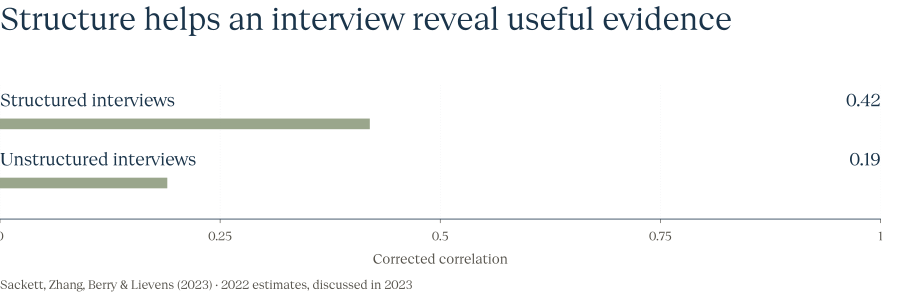
Structure helps an interview reveal useful evidence


Prepare examples that answer a clear question. A relaxed conversation can still have a thoughtful structure.
Sources & calculation notes
Source: Sackett, Zhang, Berry & Lievens (2023)
Not success percentages. Results vary: structured interviews have an 80% credibility interval of .18–.66. These are group estimates, not guarantees.
- Population
- Meta-analytic estimates across employment settings.
- Measure
- Corrected mean correlation with overall job performance.
- Source location
- Table 1, p. 285; variability discussion, p. 292.
- Checked
| Group | Value |
|---|---|
| Structured interviews | 0.42 |
| Unstructured interviews | 0.19 |
Friendly interviews can still be fair
There is a reason to care about interview structure beyond making candidates feel prepared. The US Office of Personnel Management describes structured interviews as systematic assessments of skills needed for the job. Its guidance supports consistent questions and evaluation criteria, and summarizes evidence linking structured interview performance with job performance. See the OPM guidance.
That does not require an interviewer to sound mechanical. A person can ask a clear question, listen generously, and assess the answer against a defined standard. Nor does adding more rounds automatically create better structure. The question is what information each conversation contributes and how that information is used.
From the candidate’s side, you cannot redesign the process during the call. You can make your evidence easier to understand and ask enough questions to assess the opportunity. Treat the conversation as a chance for both sides to learn, while remembering that the interviewer still has a decision to make.
Ask what later rounds involve, even if the first call is informal.
Both people have something to learn.
An informal tone does not remove the need for clear questions.

Help them understand you
Share relevant examples and explain your part in the work.
Understand the role
Ask what needs solving, what success means, and what happens next.
A better decision about continuing
Warmth and preparation can support each other.
A useful thirty minutes
- Ask what the conversation will cover. A brief message beforehand can clarify whether this is an initial introduction, a discussion about the work, or an assessment. Prepare for the actual meeting rather than the word “informal.”
- Build a ninety-second introduction. Explain the relevant thread in your experience, what you want next, and why this role caught your attention. Leave enough room for the other person to steer the discussion.
- Bring three examples you can unpack. Choose situations that reveal your judgment and contribution. Know the constraints as well as the outcome, and avoid language that claims the entire team’s work as your own.
- Reserve time for your questions. Ask about the problem behind the hire, the expectations for the role, and how success will be assessed. These answers help you decide whether continuing makes sense.
- Close with the next step. Confirm what happens after the conversation and when you should expect an update. A friendly ending is pleasant; a clear ending is useful too.
For hiring teams
Explain the format without relying on shared assumptions about what a coffee chat means. Tell candidates what you want to learn, use consistent core questions, and be explicit about the next stage. Let candidates know when their answers are being assessed.
A good conversation often ends with something you could not have rehearsed: a clearer understanding of the team, an unexpected connection, a better question. Prepare enough to be available for that. Leave room for the other person to surprise you.
About this essay
Based on client conversations, with identifying details omitted and examples adapted for clarity. The structured-interview guidance is linked in the text.